
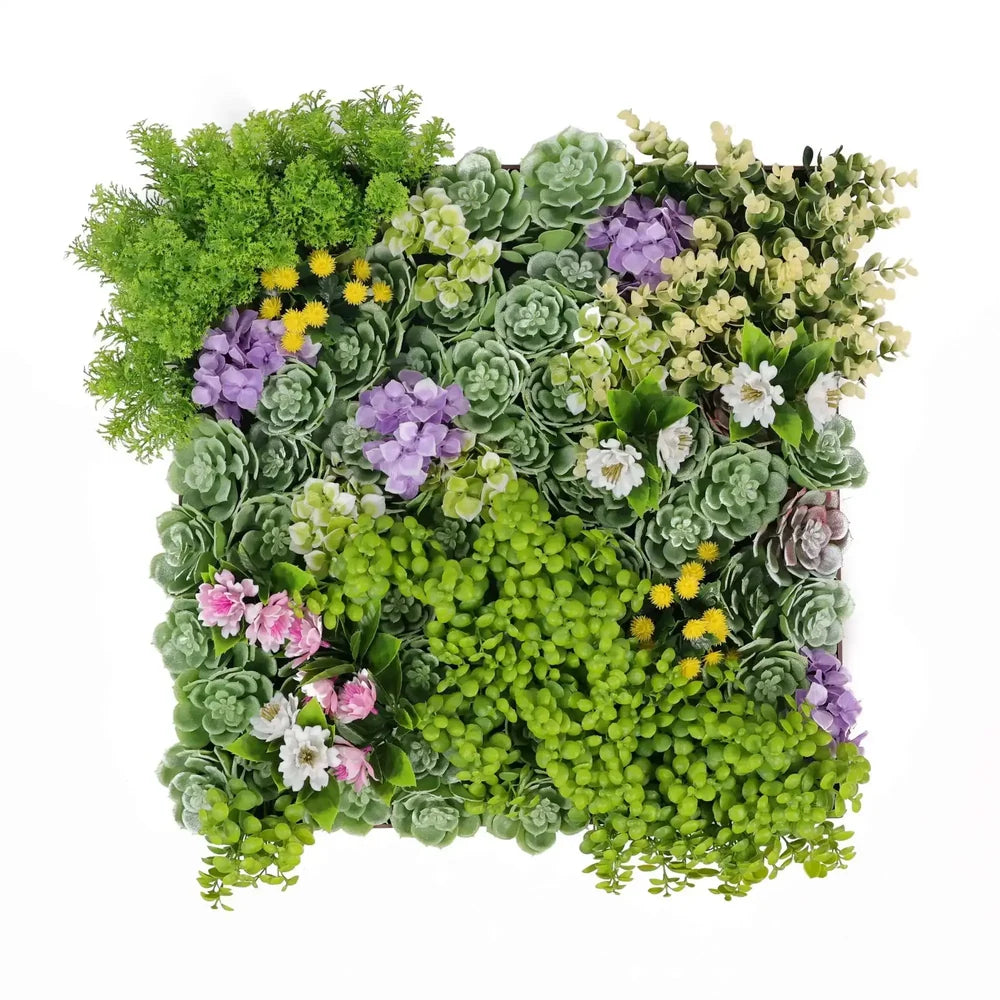
Choose artificial succulents for a wall you want people to notice up close. Choose artificial moss for a textured backdrop that lets a sign, artwork, or furniture stand out. If you only need to fill a small spot, a framed mix of both makes more sense than buying enough panels to cover the entire wall.
Succulent vs. moss: which works where?
- Reception desk or café wall: Use succulent panels if the wall itself is the feature. The individual leaf shapes give people something to look at while they wait. If your logo is the focal point, use a quieter moss texture behind it and check how the lettering reads from the doorway.
- Wide lobby wall: Start with moss, then decide whether it needs an accent at all. A repeated, lower-profile texture gives you a more even backdrop across a large area. If you want more color without prominent leaf shapes, look at the green-and-white moss panel.
- Narrow alcove or a single spot above a console: A 20-inch framed moss-and-succulent piece gives you both textures with a finished edge. Measure the available space and check projection, especially next to doors or walkways.
Three options to compare
1. Dense succulent panel: a focal section or a smaller grid
The 20 × 20-inch Dense Succulent panel covers approximately 2.8 sq. ft. by nominal dimensions. Choose it when the shape of the foliage is part of the design. On a wall viewed from one side, look at the panel from that angle before deciding where to finish the edges.

2. Green-and-white moss panel: a broader backdrop
The 40 × 40-inch Green and White Moss panel covers approximately 11.1 sq. ft. by nominal dimensions. One panel takes up the same wall area as four 20-inch panels, so there are fewer individual pieces to place across the same area. For a greener, more uniform look, also compare the Evergreen Moss Mat set (listed at 33 sq. ft.).

3. Framed moss and succulents: a standalone accent
The 20-inch square Moss & Succulent Wall Art Frame combines both looks in one piece. Choose it if you want a contained display with an intentional border. It’s wall art, not a substitute for edge-to-edge panels if you’re trying to cover a whole wall.
What to measure before ordering
Measure the width and height of the actual green area, excluding any trim or space you want to leave bare. A 60 × 40-inch rectangle takes six nominal 20-inch panels, laid out three across and two high. Using 40-inch panels instead means working out how you’ll finish the remaining 20 inches. Check the actual backing size and whether you can trim it before ordering, especially if the wall isn’t perfectly square.
If you’re putting greenery behind a sign, tape an outline of the lettering on the wall and step back to the usual viewing distance. Check the contrast under the actual lighting. For an outdoor position or a commercial site with fire-performance requirements, confirm suitability and any necessary documentation for the exact product. UV resistance is not a fire rating.
Browse artificial moss panels and framed accents or compare the full green wall range. If you’re planning a reception or commercial feature wall, email the DVG team the wall dimensions and a straight-on photo so we can help you compare layouts.